The real advantages of drone cleaning for industrial assets
Traditional cleaning methods like scaffolding, rope access, and manual spraying are slow, risky, and often miss hard-to-reach areas. Modern industrial drones change that by delivering precision cleaning without putting humans at height.
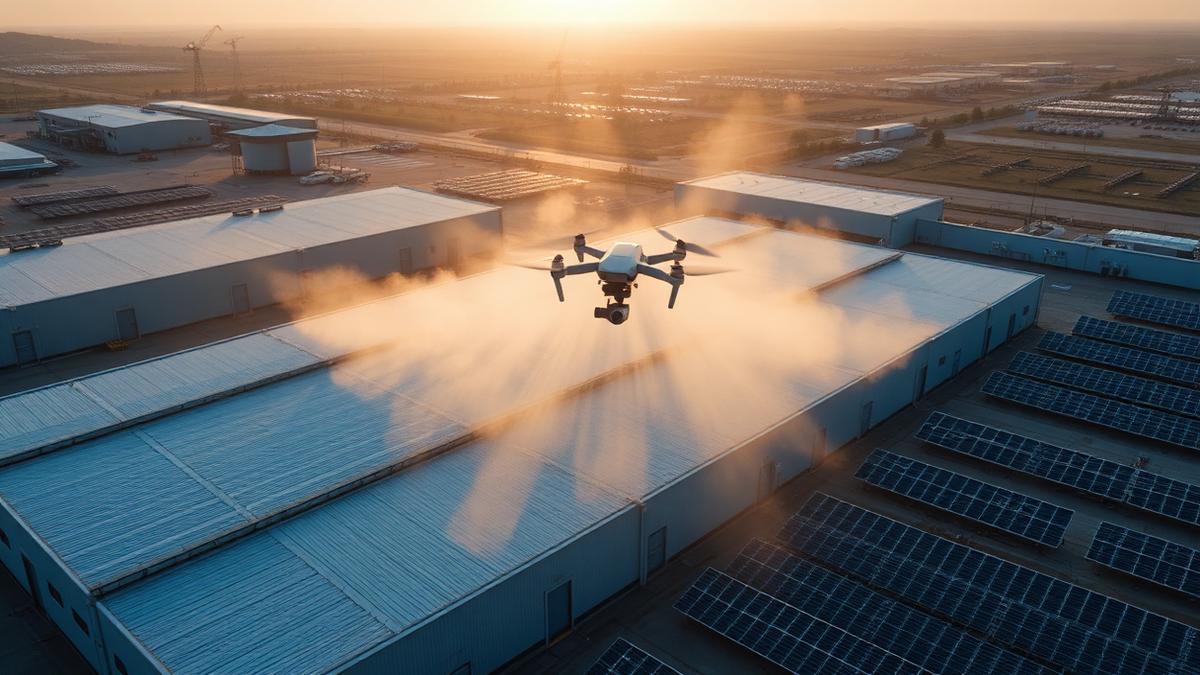
Eliminating work-at-height hazards with zero personnel exposure
Industrial asset maintenance has long been constrained by the physical hazards, high financial costs, and logistical friction of manual access at height1. Infrastructure such as high-rise glass curtain walls, commercial wind turbine blades, utility-scale photovoltaic arrays, petrochemical storage tanks, and high-voltage electrical insulators requires routine decontamination to prevent structural corrosion, efficiency loss, and component failure3.
Traditional access techniques—including scaffolding, swing stages, mobile elevating work platforms (MEWPs), and industrial rope access—are slow to deploy, labor-intensive, and carry substantial safety risks1. Manual washing crews suspended hundreds of feet in the air face extreme physical strain, weather exposure, and reactive forces from high-pressure spray equipment2.
Surface Access Strategic Comparison
Traditional Access Methods: Depend on physical scaffolding, aerial platforms, or rope suspension. Up to 80% of project budgets are consumed by equipment assembly and site management, while workers remain exposed to significant fall hazards and physical fatigue.
Industrial Drone Washing: Managed completely from a ground station. Flight crews operate at ground level, utilizing millimeter-wave radar and RTK positioning to maintain stable, precise surface standoff without placing personnel at height3.
Heavy-lift industrial drones equipped with continuous fluid supply systems offer a safer alternative by moving high-altitude cleaning to a ground-controlled workflow1.
The flight team—comprising a remote pilot and a ground station technician—manages the entire process safely from the ground. This eliminates fall hazards, lowers liability insurance overhead, and removes the need for complex fall-arrest rigging.
Dual-band Real-Time Kinematic (RTK) satellite positioning, millimeter-wave radar, and ultrasonic obstacle sensing enable these platforms to operate safely near complex structural geometries1. They automatically compensate for wind gusts up to 12 m/s while maintaining precise, repeatable standoff distances from vertical surfaces1.
Operational Criteria
| Traditional Rope Access | Scaffolding & Swing Stages | Tethered Drone System | |
|---|---|---|---|
| Worker Height Exposure | High (100% of operational time) | High (Assembly, usage, teardown) | Zero (Ground station execution) |
| Setup & Mobilization | 4 to 24 Hours | 2 to 10 Days | 1 to 15 Minutes8 |
| Cleaning Speed | 50–100 m²/hour per technician4 | 100–150 m²/hour per crew | 500–1,000 m²/hour per drone1 |
| Wind Operating Limit | 8–10 m/s maximum | 8–11 m/s maximum | 12 m/s sustained |
| Indirect Overhead Cost | Moderate (Rigging & Safety Checks) | High (50%–80% of project total) | Low (Ground station setup only) |
System architecture, fluid dynamics, and thrust compensation
Transforming a multi-rotor drone into an effective washing platform requires addressing several engineering challenges, including fluid dynamics, mass balance, and aerodynamic recoil compensation. Industrial platforms use two primary configurations: onboard storage tanks and ground-tethered supply lines6.
Onboard tank systems carry 10 to 62 liters of fluid directly on the airframe6. While highly mobile, flight duration is limited by payload weight, restricting missions to 7 to 30 minutes before landing and refilling6.
For large-scale industrial projects, tethered supply architectures are the standard choice1. A high-pressure ground pump delivers cleaning fluids through a lightweight polymer hose reaching heights of 100 to 200 meters. By removing fluid weight from the airframe, the drone can run continuous cleaning passes uninterrupted, bounded only by battery swaps or ground power connections6.
The Fluid Delivery Workflow
Ground Reservoir & Water Conditioning: Water and eco-friendly cleaning agents are blended and conditioned at the ground station4.
Ground Pressurization: Positive-displacement triplex plunger pumps pressurize the fluid to 30–35 MPa (300–350 bar) at flow rates of 15–38 L/min1.
Tether Delivery: Fluid is pumped up through lightweight, high-strength tether hoses (such as Blupur systems) that reduce airborne hose weight by over 50%.
Aerial Pressure Spray: The fluid flows through a rigid 1,500 mm carbon-fiber boom or an oscillating spray head directly onto the surface.
Pumping fluid to elevation creates static hydrostatic pressure losses governed by the formula:
Hydrostatic Pressure Loss = Fluid Density * Gravity * Operating Altitude
Where fluid density is approximately 1,000 kg/m³, gravity is 9.81 m/s², and altitude is working height in meters. At an elevation of 40 meters, static pressure drops by approximately 3.92 bar (~4 bar) due to gravity alone, before accounting for internal hose friction2. High-pressure ground skids compensate for this drop to maintain optimal pressure at the nozzle6.
To handle the backward recoil force created by high-pressure spray, modern cleaning drones combine three dynamic controls:
Recoil Force = (Mass Flow Rate * Fluid Exit Velocity) + [Nozzle Orifice Area * (Exit Pressure - Atmospheric Pressure)]
Closed-Loop RTK Flight Control: Dual RTK modules deliver positional updates to the flight computer, adjusting motor thrust in milliseconds to counter nozzle recoil1.
Ground Foot Switch Activation: Flight stick movements are kept separate from water flow controls2. A ground technician operates a high-pressure foot switch to start fluid flow once the pilot has stabilized the hover, avoiding sudden pitch shifts2.
Rigid Booms and Oscillating Mounts: Carbon-fiber booms (typically 1,500 mm long) extend nozzles away from the propellers to prevent spray recirculation. Powered 45-degree oscillating heads sweep the spray pattern across target surfaces without requiring aggressive airframe maneuvers.
Cleaning methodologies: High-pressure mechanical vs. chemical soft wash
Different industrial surfaces require tailored cleaning approaches based on material strength, delicate coatings, and the type of surface buildup1. Drones operate using two main approaches: high-pressure mechanical washing and low-pressure chemical soft washing12.
Cleaning Mode Selection Workflow
High-Pressure Mechanical Wash: Applied at 25 to 35 MPa for heavy contamination (concrete, raw metals, heavy mineral scale). Relies on high-velocity kinetic impact using polymer rotary nozzles to strip soil.
Low-Pressure Chemical Soft Wash: Applied at 1.5 to 3.0 MPa for fragile substrates (architectural glass, solar PV, coated cladding). Uses specialized biodegradable detergents to dissolve grime, followed by a low-pressure rinse.
High-Pressure Mechanical Washing
High-pressure washing uses kinetic impact force to break down stubborn mineral buildup, heavy soot, grease, and industrial grime1. Operating at 25 to 35 MPa, this method is ideal for durable surfaces like reinforced concrete, unpainted steel, and masonry structures.
To maximize impact while managing weight, cleaning drones use lightweight rotary (turbo) nozzles made from glass-fiber-reinforced polymers. These polymer nozzles are nearly 200 grams lighter than standard brass versions, helping save payload capacity and extend battery efficiency during flight2.
Low-Pressure Chemical Soft Washing
Delicate assets—such as solar panels, composite wind turbine blades, architectural glass, and painted metal panels—can suffer damage from high mechanical pressure. These surfaces use low-pressure soft washing instead6. Soft washing applies specialized cleaning solutions at 1.5 to 3.0 MPa (215 to 435 PSI) with higher flow rates, using chemistry rather than high pressure to break down contaminants6.
Chemical formulations are chosen based on the specific surface buildup9:
Organic Bio-Fouling (Algae, Mildew, Mold): Mild sodium hypochlorite solutions mixed with surfactants that cling to vertical surfaces to break down biological growth5.
Industrial Hydrocarbons & Oils: Environmentally friendly alkaline degreasers that break down grease and exhaust films on building facades12.
Oxidation & Mineral Stains: Target restoration cleaners that lift metallic oxidation from anodized metal panels without damaging factory coatings12.
| Surface / Asset Type | Primary Cleaning Approach | Working Pressure Range | Nozzle & Chemical Configuration | Target Cleaning Objective |
|---|---|---|---|---|
| Glass Curtain Walls | Low-Pressure Soft Wash | 2.0–10.0 MPa (290–1,450 PSI)3 | ProTool Red cleaners; 40° wide fan nozzle12 | Streak-free visual finish; seal protection12 |
| Photovoltaic Solar Arrays | Low-Pressure Soft Wash | 1.5–3.0 MPa (215–435 PSI)6 | Neutral pH anti-static surfactants; 25° fan | Dust/soiling removal; zero thermal shock |
| Wind Turbine Blade Edges | Soft Wash & Rinse Combo | 10.0–25.0 MPa (1,450–3,625 PSI)6 | Insect solvents; polymer rotary nozzles | Leading-edge drag reduction & surface restoration |
| Petrochemical Storage Tanks | High-Pressure Mechanical Wash | 25.0–35.0 MPa (3,625–5,075 PSI) | Pure water kinetic jet; 0° or 15° nozzle | Heavy sludge removal; surface prep for inspection |
| Substation Insulator Strings | High-Pressure Pure Water Wash | 10.0–20.0 MPa (1,450–2,900 PSI)7 | Deionized high-resistivity water; narrow stream13 | Flashover prevention on energized lines |
Automated navigation, surface tracking, and digital twin inspection
Modern cleaning drones do more than deliver fluids—they double as autonomous mapping and inspection platforms. Equipped with dual-band RTK GNSS receivers, millimeter-wave radar, RGB cameras, and LiDAR sensors, these systems convert routine cleaning into repeatable digital workflows1.
Autonomous Navigation Framework
Satellite RTK Network: Receives dual-band geodetic corrections for centimeter-level spatial lock (1 cm + 1 ppm)11.
Flight Control Engine: Ingests 3D structural models to calculate optimized flight routes across asset facades.
Surface-Tracking Radar: Continuously calculates surface distance to maintain an exact 2 to 3 meter standoff.
Dynamic Thrust Compensation: Adjusts motor speeds instantly to offset nozzle spray recoil3.
Dual-band RTK systems provide sub-centimeter positioning accuracy (1 cm + 1 ppm horizontal and 1.5 cm + 1 ppm vertical). Flight control software ingests 3D structural models to create automated grid patterns across asset surfaces. The drone flies controlled passes with fixed line spacing to maintain an even 30% to 50% spray overlap. Forward-facing radar continuously tracks the asset surface, keeping a consistent 2 to 3 meter working distance regardless of architectural setbacks or wind shifts.
Cleaning passes can also be paired with structural health inspections3. Equipping the drone with photogrammetry payloads (such as the 45 MP Zenmuse P1) or active LiDAR sensors (such as the Zenmuse L2) captures high-resolution asset condition data during or immediately after washing14.
Dual-Sensor Inspection Capabilities
Photogrammetry Sensors: Capture 45 MP RGB images to construct textured, photorealistic 3D digital meshes. Highly effective for inspecting fine visual defects such as concrete cracks down to 0.2 mm width, spalling, and surface corrosion13.
Aerial LiDAR Sensors: Emit active laser pulses to build direct 3D geometric point clouds. Unaffected by poor lighting, LiDAR accurately captures thin structural elements like guy wires, truss networks, and power lines3.
| Inspection Capability | Photogrammetry Payload (e.g., Zenmuse P1) | Aerial LiDAR Sensor (e.g., Zenmuse L2) |
|---|---|---|
| Primary Data Deliverable | Photorealistic 3D Mesh & True Orthomosaic3 | High-Density 3D Point Cloud3 |
| Absolute Geodetic Accuracy | 1–3 cm Horizontal / 2–5 cm Vertical (with RTK)12 | 5 cm Horizontal / 4 cm Vertical15 |
| Visual Feature Identification | High (Detects surface cracks down to 0.2 mm) | Low (Geometric point distribution only)14 |
| Lighting Requirements | High (Requires consistent daylight)12 | None (Operates in complete darkness) |
| Structural Geometry Mapping | Captures solid, textured surfaces | Maps thin cables, power lines, & trusses |
Economic impact, time savings, and real-world ROI
The financial argument for cleaning drones centers on lower operating expenses, reduced setup delays, and significantly higher cleaning throughput. In traditional high-rise cleaning, fluid and labor costs account for only a fraction of the overall budget. Scaffolding permits, staging rentals, sidewalk closures, and traffic control typically represent 50% to 80% of total project spending2.
| Budget Expenditure Category | Traditional Manual Access Method | Tethered Industrial Drone Method |
|---|---|---|
| Indirect Setup & Equipment | 50% – 80% (Scaffolding, lifts, permits)2 | 10% – 30% (Ground station & consumables)2 |
| Direct Cleaning Operations | 20% – 50% (Manual labor suspended at height) | 70% – 90% (Active UAV execution)2 |
Tethered drones eliminate the need for heavy access equipment2. The entire cleaning platform—including pumping skids, water filtration units, generators, and flight hardware—transports within a single service vehicle6. Operational setup takes only 1 to 15 minutes upon arriving at the site.
Workplace throughput gains are equally significant1. Suspended rope access technicians clean an average of 50 to 100 square meters per hour, whereas an industrial cleaning drone delivers processing speeds of 500 to 1,000 m²/hour.
| Cleaning Method | Typical Surface Area Throughput Rate |
|---|---|
| Manual Rope Access Suspension | ~100 m²/hour per technician |
| Drone Deep Mechanical Wash | ~500 m²/hour per drone unit3 |
| Drone Light Soft Wash | ~1,000 m²/hour per drone unit3 |
Real-World Field Case Study: Commercial High-Rise
During facade maintenance at the Taizhou Talent Building—a complex featuring over 10,000 square meters of glass curtain wall—traditional planning called for a 6-person rope access crew working over 5 days (240 total labor hours)4.
Deploying a tethered drone cleaning system completed the entire 10,000 m² glass facade in 18 operational hours with a 2-person ground crew4. This approach reduced site labor hours by over 85%, eliminated street-level pedestrian disruptions, and cut water usage by over 60% through automated spray control and fine fluid atomization4.
| Operational Metric | Manual Rope Access Crew | Dual Tethered UAV Platform | Performance Improvement |
|---|---|---|---|
| On-Site Field Crew Size | 6 Suspended Technicians4 | 2 Ground Station Operators4 | 66% Personnel Reduction |
| Total Project Duration | 120 Hours (5 Days)4 | 18 Operational Hours4 | 85% Time Savings |
| Resource Consumption | High (Unregulated continuous flow) | Optimized (>60% Water Saved)4 | Sustainable Water Footprint |
| Height Risk Exposure | 240 Person-Hours suspended at height | 0 Person-Hours at height | 100% Fall Hazard Mitigation |
Best practices for enterprise deployment
To maximize efficiency and safety when implementing drone cleaning operations, facilities teams should follow these core recommendations:
Pre-Mission Digital Standoff Audits: Run a fast RTK mapping pass before cleaning to generate a 3D obstacle model of the structure. Pre-mapping helps identify structural protrusions, guy wires, and fragile elements before pressurizing fluid lines.
Dynamic Pressure Tuning: Match nozzle pressures directly to substrate strength. Keep solar arrays and glass curtain walls under 3.0 MPa using chemical soft-washing solutions, while reserving 25 to 35 MPa high-pressure passes for unpainted concrete and heavy steel.
Decouple Flight and Hydraulic Controls: Maintain standard safety protocols by using a ground foot switch for fluid delivery2. This allows pilots to focus fully on flight controls during system startup while a secondary operator manages fluid flow2.
Combined Cleaning and Inspection Workflows: Leverage each flight pass by collecting high-resolution RGB imagery or LiDAR data during or immediately after washing, delivering updated asset digital twins alongside clean infrastructure3.